Germany has quietly become one of the most rewarding destinations in the world for students who want their degree to translate into a serious career. A combination of low or zero tuition at public universities, a stable euro-denominated salary market, and a chronic shortage of skilled workers across engineering, technology and healthcare has turned the country into a magnet for international talent.
For 2027, the picture gets even more attractive. The expanded Chancenkarte (Opportunity Card), the simplified EU Blue Card route for shortage occupations, and Germany’s official target of welcoming 400,000 skilled professionals every year mean graduates are walking into an employment market that genuinely wants them.
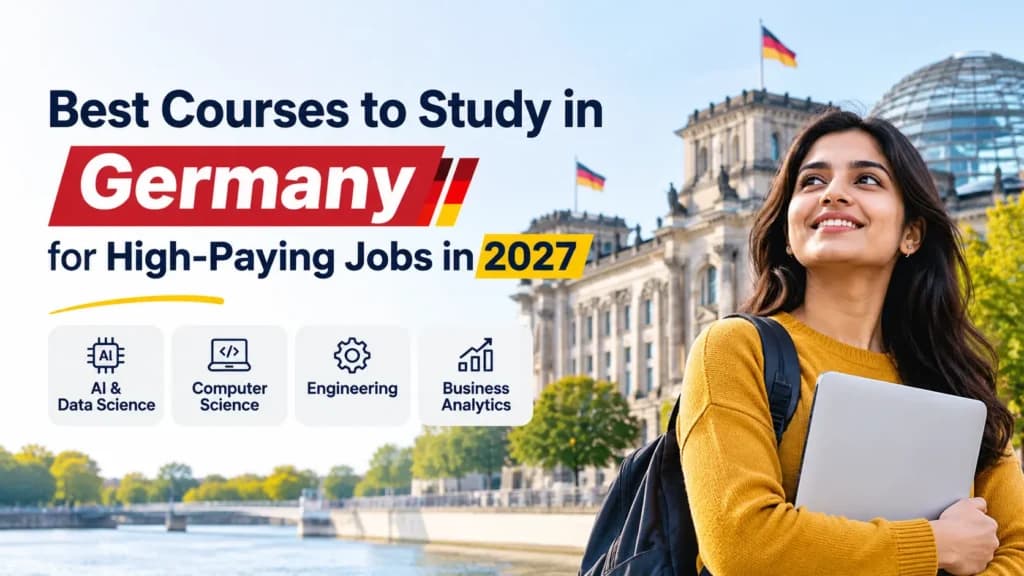
If you are weighing where to study for the strongest return on your investment, this guide breaks down the courses most likely to translate into a high-paying job in Germany in 2027 — with realistic starting salaries, the industries hiring, and the universities recognised for each field.
Why Germany is a high-salary destination in 2027
Three forces are reshaping the German job market this decade.
Demographics. More than four million workers are expected to retire by 2035, and the country simply does not have enough domestic graduates to replace them. Entire industries — engineering, IT, healthcare, skilled trades — are facing a structural talent gap.
Policy. The Skilled Immigration Act now allows international graduates an 18-month post-study work permit to find a job matching their qualification. The EU Blue Card salary threshold has been relaxed for shortage occupations, and the Chancenkarte (points-based Opportunity Card) lets qualified candidates enter Germany even before securing a job offer. Permanent residency is possible within 21–27 months of starting a qualified role.
Industry. Germany’s twin bets on Industrie 4.0 (advanced manufacturing + automation) and the Energiewende (green energy transition) have created enormous appetite for engineers, data specialists and researchers. Public and private R&D spending now sits above 3% of GDP, one of the highest ratios in the world.
The practical upshot for international students is clear — the right course, paired with reasonable German-language progress, can lead to a €55,000–€95,000 starting salary and a direct pathway to permanent residency within three years.
The 7 best courses to study in Germany for high-paying jobs in 2027
The courses below are chosen on three criteria: strong hiring demand in 2027, published average starting salaries above €55,000, and genuine openness to international graduates. Each pairs a well-regarded academic programme — most searchable on the DAAD International Programmes database — with industries actively recruiting non-EU talent.
1. Data Science & Artificial Intelligence
Few fields have moved as fast as AI in the last two years, and German industry is racing to catch up. SAP, Siemens, BMW, Bosch and the country’s rapidly scaling AI start-up scene are all hiring data scientists, ML engineers and applied researchers. Public-sector adoption of generative AI — from the Bundesagentur für Arbeit to Deutsche Bahn — is adding another layer of demand.
- Average starting salary: €65,000 – €85,000, climbing past €110,000 within four to five years.
- Top universities: TU Munich (TUM), TU Berlin, RWTH Aachen, Universität Tübingen, LMU Munich. Most Master’s programmes are taught entirely in English.
- Graduate roles: Data Scientist, Machine Learning Engineer, AI Researcher, NLP Engineer, MLOps Engineer.
- Ideal background: Computer Science, Mathematics, Statistics or Engineering.
2. Mechanical Engineering
Mechanical engineering remains Germany’s calling card. The country’s Mittelstand — its mid-sized industrial champions — along with giants like Siemens, Bosch, Krones and ThyssenKrupp continue to export precision machinery worldwide and need engineers who can design, automate and maintain it.
- Average starting salary: €55,000 – €70,000, with experienced specialists in automation and robotics crossing €90,000.
- Top universities: RWTH Aachen, TU Munich, KIT Karlsruhe, TU Darmstadt, University of Stuttgart. German-taught Bachelor’s programmes are common; English-taught Master’s are plentiful.
- Graduate roles: Design Engineer, Automation Engineer, Robotics Engineer, R&D Engineer, Production Manager.
A German-language level of B2 significantly lifts your interview chances at traditional manufacturers, so pairing the degree with a parallel language course is a smart move.
3. Automotive Engineering & Electric Mobility
Germany’s automotive industry employs roughly 800,000 people and is in the middle of its most consequential transition in a century — the switch to electric and software-defined vehicles. BMW, Mercedes-Benz, Volkswagen, Audi, Porsche and a new wave of battery and powertrain specialists are hiring aggressively for EV platforms, battery technology, hydrogen propulsion and autonomous driving.
- Average starting salary: €60,000 – €80,000, with battery and autonomous-systems engineers often earning €90,000+ by year three.
- Top universities: TU Munich, RWTH Aachen, TU Braunschweig (home to Automotive Systems Engineering), Esslingen University, FAU Erlangen-Nürnberg.
- Graduate roles: EV Powertrain Engineer, Battery Systems Engineer, Autonomous Vehicles Engineer, ADAS Developer, Vehicle Software Engineer.
Students with a mechatronics or software background are especially well-placed for the most software-heavy — and best-paid — openings.
4. Cybersecurity & Information Security
Germany’s cybersecurity workforce gap now sits above 100,000 open positions, and the attack surface — from Mittelstand manufacturers to public utilities — keeps growing. The federal government, Deutsche Telekom, SAP and specialist firms such as Rohde & Schwarz Cybersecurity are hiring at every level.
- Average starting salary: €60,000 – €80,000, with senior roles in cloud and OT security clearing €100,000.
- Top universities: TU Darmstadt (globally ranked CRISP research hub), Saarland University, Ruhr-Universität Bochum, TU Munich. Many Master’s programmes are taught in English and explicitly designed for international intake.
- Graduate roles: Security Analyst, Penetration Tester, Cloud Security Engineer, SOC Analyst, OT / ICS Security Engineer.
Industry certifications — CEH, OSCP, CISSP track — alongside the degree make graduates very hard to overlook.
5. Renewable Energy & Sustainable Engineering
Germany’s Energiewende is one of the largest planned energy transitions in the world — targeting 80% renewable electricity by 2030 and full climate neutrality by 2045. That translates into sustained hiring for engineers who can plan, build and integrate wind, solar, hydrogen and grid-storage systems.
- Average starting salary: €55,000 – €75,000, with experienced power-systems and hydrogen engineers climbing to €90,000+.
- Top universities: TU Berlin, University of Freiburg, Oldenburg, University of Leipzig, University of Kassel. Dedicated English-taught Master’s programmes include Renewable Energy Engineering and Sustainable Energy Technology.
- Graduate roles: Wind / Solar Engineer, Grid Integration Engineer, Hydrogen Systems Engineer, Energy Systems Analyst, Sustainability Consultant.
This is one of the most policy-backed sectors in Europe — public and private funding is likely to keep demand elevated well past 2030.
6. MBA / International Management
A German MBA is one of the few in Europe that routinely pairs business education with direct recruitment pipelines into DAX-listed corporations and Mittelstand global champions. Top schools draw recruiters from Mercedes-Benz, BMW, Allianz, SAP, Deutsche Bank, Henkel and the Big Four consulting firms.
- Average starting salary: €70,000 – €110,000 depending on school and sector; consulting and tech management lead the pack.
- Top schools: Mannheim Business School, ESMT Berlin, Frankfurt School of Finance & Management, HHL Leipzig, WHU Otto Beisheim. Most two-year programmes are taught entirely in English.
- Graduate roles: Management Consultant, Product Manager, Strategy Associate, Finance Manager, Business Development Lead.
An MBA works best for candidates with three to five years of professional experience; younger applicants are often better served by a Master’s in International Business or International Management.
7. Biotechnology & Pharmaceutical Sciences
BioNTech put Germany on the global biotech map, and the pipeline behind it is still expanding. Bayer, Merck KGaA, Boehringer Ingelheim, Qiagen and a dense cluster of biotech scale-ups across Munich, Berlin and the Rhine-Main region are actively hiring researchers, process engineers and regulatory specialists.
- Average starting salary: €55,000 – €75,000, with specialists in cell therapy, mRNA and biomanufacturing crossing €90,000 in four to five years.
- Top universities: University of Heidelberg, LMU Munich, TU Munich, Göttingen, University of Freiburg. English-taught Master’s programmes are widely available.
- Graduate roles: Biotechnology Research Scientist, Bioprocess Engineer, Clinical Research Associate, Regulatory Affairs Specialist, Quality Control Analyst.
Pharma roles typically require Master’s-level qualifications; a doctorate becomes near-mandatory for senior R&D positions, but the salary jump justifies the extra time.
Salary & demand snapshot (2027)
| Course | Starting Salary (€ / year) | Experienced Salary (€ / year) | Industry Demand |
|---|---|---|---|
| Data Science & AI | 65,000 – 85,000 | 100,000 – 130,000 | Very High |
| Mechanical Engineering | 55,000 – 70,000 | 85,000 – 110,000 | High |
| Automotive & EV | 60,000 – 80,000 | 90,000 – 120,000 | Very High |
| Cybersecurity | 60,000 – 80,000 | 95,000 – 120,000 | Very High |
| Renewable Energy | 55,000 – 75,000 | 85,000 – 110,000 | High |
| MBA / Management | 70,000 – 110,000 | 120,000 – 180,000 | High |
| Biotechnology & Pharma | 55,000 – 75,000 | 90,000 – 115,000 | High |
How to pick the course that pays off for you
A high starting salary only tells half the story. Four questions will sharpen your decision:
Does the industry match the way you like to work? Automotive and mechanical engineering reward hands-on, team-driven problem solvers. Data science and cybersecurity reward solo depth and continuous self-learning. Biotech and renewable energy sit somewhere in between — lab-based collaboration mixed with long research cycles.
Where is the employer base located? Automotive clusters around Munich, Stuttgart and Wolfsburg. Biotech is strongest in Munich, Berlin and the Rhine-Main region. Finance, consulting and MBA recruiting concentrate in Frankfurt and Düsseldorf. Renewable energy hubs sit in Hamburg, Leipzig and Freiburg.
How steep is the language expectation? Research-heavy programmes and most Master’s are taught in English, but moving into mid-senior industry roles usually demands B2 German within three years. Plan language learning alongside your degree, not after it.
How well does the university connect you to industry? Programmes with mandatory internships, co-operative placements with corporate partners, or tight Mittelstand links typically shorten the time to first job offer by several months.
Picking the right combination of course, city and language path matters as much as the subject itself.
Final Thoughts
Germany in 2027 offers something uncommon — serious earning power in stable euros, generous post-study work rights, and a direct pathway to permanent residency for graduates who commit to the language. The seven courses above are not simply “good degrees.” They are the entry points to the sectors Germany is actively investing in for the next decade.
The hardest part is rarely the academics. It is choosing the right programme, assembling a competitive APS-cleared application, and timing admission intakes correctly for a 2027 or 2028 start.
That is where YesGermany comes in. As one of India’s most trusted study-in-Germany consultancies, our team handles everything from shortlisting the right university to APS certification, blocked account setup, visa documentation and post-arrival settlement — so you can focus entirely on your studies and your career.
Ready to begin? Talk to a YesGermany counsellor today for a free profile evaluation and a personalised university shortlist. Your high-paying German career could start with one conversation.