
Picture this. A middle-class family in Pune is sitting at the dining table on a Sunday evening. Their daughter has just scored 86% in her Bachelor’s degree and wants to pursue a Master’s in Mechanical Engineering abroad. The father opens a US university page, sees ₹55 lakh in tuition, and quietly closes the laptop. The mother suggests the UK — tuition drops to ₹35 lakh, but the one-year degree feels rushed and the Graduate Route visa keeps shrinking in the news.
Then a cousin visiting from Munich walks in and says one line that changes the room: “Beti ko Germany bhejo. Fees almost zero hai, aur Master’s ke baad job bhi lag jaati hai.”
This exact conversation is happening in thousands of Indian homes right now. And the data agrees with that cousin. According to the latest release from the German Academic Exchange Service (DAAD) and Germany’s Federal Statistical Office Destatis, Indian students are the single largest group of international students in Germany for the second year running — firmly ahead of China. A record 69,816 Indian students enrolled in Winter Semester 2025/26, a 17.5% jump in just one year, and the number is projected to cross 80,000 by 2027.
So, is Germany really the best country to study abroad in 2027? After working closely with hundreds of Indian students and their parents over the last few years, my honest answer is a confident yes — and in this complete guide, I will walk you through exactly why, with real examples, actual numbers, and the hard truths no agent will tell you upfront.
Why Germany Stands Out for Indian Students — At a Glance
Before we dive deep, here is the whole case for Germany in one quick-scan table. Every number below is backed up section by section in the rest of this guide.
| Factor | What You Get in 2027 |
|---|---|
| Public university tuition | €0 (semester fee only €150–€350) |
| Blocked Account required | €11,904 (~₹10.7 lakh — your own money, released monthly) |
| English-taught Master’s programs | 2,100+ across Germany |
| Post-study work visa | 18 months, automatic, no sponsor needed |
| Path to Permanent Residency | 21–33 months after employment |
| Avg. starting salary (Master’s) | €55,000–€72,000 (~₹49–65 lakh/year) |
| Indian student population (Winter 2025/26) | 69,816 — up 17.5% YoY, India is #1 source country |
| Safety ranking (Global Peace Index) | 15th in the world |
Now let us look at each of these reasons in depth, with real examples from Indian students who have already made the move.
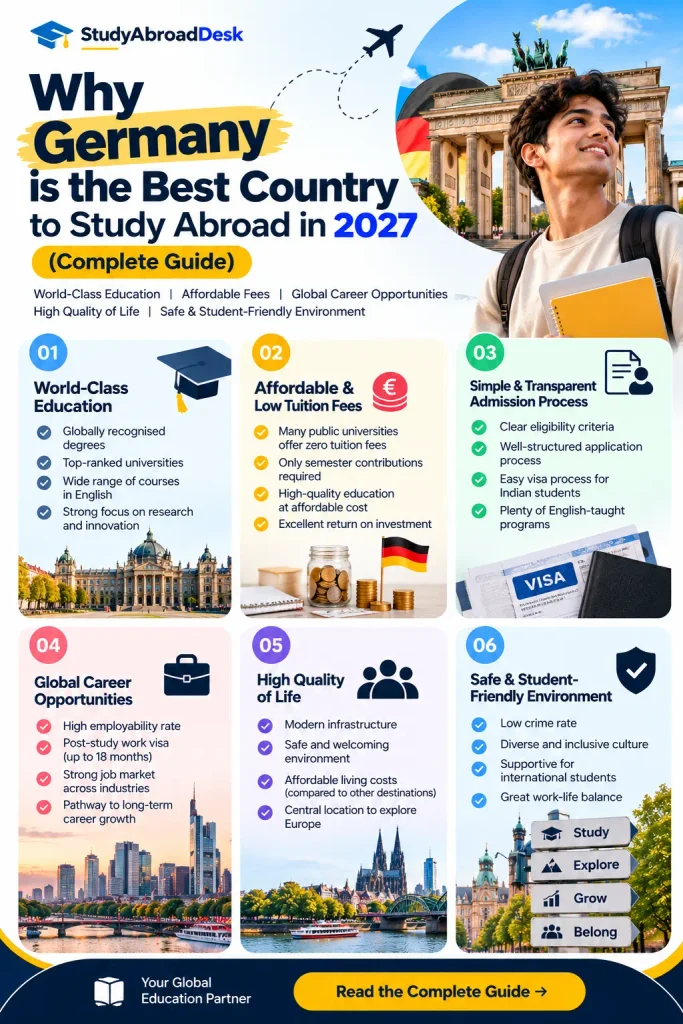
1. World-Class Education at Almost Zero Tuition
Let me start with the single biggest reason Germany sits at the top of the 2027 study-abroad list for Indian families: public universities in Germany charge no tuition fees. Not low fees. Zero tuition.
All 16 federal states of Germany abolished tuition fees for public universities back in 2014, and even in 2026, this policy has held firm for international students at every state except Baden-Württemberg (which charges a modest €1,500 per semester for non-EU students). What a student does pay is a semester contribution of roughly €150 to €350, which usually includes a free public transport pass for the entire state.
Let me put that in perspective with a real comparison from a student I worked with last year.
Rohan, a Computer Science graduate from VIT Vellore, had three admits in hand for Winter 2026 — Purdue University (USA), University of Birmingham (UK), and Technical University of Munich (TUM, Germany). Here is what his two-year Master’s actually cost his parents:
| University | Total Tuition (2 years) | In INR (approx.) |
|---|---|---|
| Purdue University, USA | ₹50,00,000 | ₹50 lakh |
| University of Birmingham, UK | ₹35,00,000 (1 year) | ₹35 lakh |
| TU Munich, Germany | €600 total (semester contribution) | ₹54,000 |
Rohan’s parents did not take an education loan. They did not sell any property. They simply paid his living expenses from their savings, and his tuition bill for the entire Master’s was less than the cost of one month’s rent in Boston. That is the Germany advantage, and it is not a loophole — it is national education policy.
Quick tip for applicants: If a Master’s degree is your plan, start by browsing field-wise and intake-wise options for a Master’s in Germany — it is the fastest way to shortlist 5–6 programs that match your academic background.
2. Globally Ranked Universities with Industry-First Programs
Free education is only valuable if the quality is world-class. And here Germany quietly outperforms almost every destination except the US.
In the QS World University Rankings 2026, Germany has 51 universities in the global top 1,000. The Technical University of Munich sits at #28 worldwide, LMU Munich at #59, and Heidelberg University at #87. The TU9 alliance — Germany’s answer to the Ivy League, made up of its nine leading technical universities including TU Berlin, RWTH Aachen, KIT, and TU Dresden — produces engineering graduates who are hired directly by BMW, Siemens, Bosch, SAP, Mercedes-Benz, Porsche, and Volkswagen before they even defend their thesis.
For Indian students, three things matter more than the ranking number:
- English-taught Master’s programs are everywhere. In 2026, over 2,100 Master’s programs across Germany are taught entirely in English. You do not need to learn German to start your degree, though learning it does help with jobs later.
- Industry collaboration is baked into the curriculum. Programs at RWTH Aachen or Fraunhofer-partnered universities require a 6-month paid industry project. Think of it as a built-in internship with a global company, usually paid €1,200–€2,000 per month.
- STEM dominance. Germany is Europe’s engineering capital. If your field is Mechanical, Automotive, Electrical, Computer Science, Data Science, AI, Renewable Energy, Biotech, or Pharmaceuticals — Germany has a specialised Master’s for it, often with better lab infrastructure than Indian IITs.
I recently helped a student from Hyderabad get into TU Dresden’s Nanoelectronic Systems program. The university assigned her a research supervisor from Infineon in week two. By the end of her first semester, she had a signed working-student contract. That is not an exception. That is how the system is designed.
Shortlisting tip: A curated side-by-side view of the top universities in Germany — filtered by TU9, Elite, Research, and Applied Sciences categories — makes it much easier to decide where to apply first.
3. Affordable Cost of Living — and Complete Financial Clarity
Parents always ask me the same question: “Beta, agar fees nahi hai, toh kharcha kitna hoga?” (If there is no tuition, what will the monthly expenses be?)
Here is a realistic monthly budget for an Indian student in 2027, broken down by city tier:
| Expense | Berlin / Munich (Tier 1) | Dresden / Aachen (Tier 2) | Magdeburg / Cottbus (Tier 3) |
|---|---|---|---|
| Rent (shared / student dorm) | €450–€650 | €300–€400 | €220–€320 |
| Groceries | €200 | €180 | €170 |
| Health insurance (mandatory) | €130 | €130 | €130 |
| Transport (semester ticket included) | €0–€49 | €0–€49 | €0–€49 |
| Mobile, internet, misc. | €60 | €60 | €60 |
| Total monthly | €850–€1,050 | €680–€820 | €580–€730 |
In Indian rupees, a student living comfortably in Dresden spends roughly ₹68,000 per month in 2027 — the same amount a student would spend in a one-bedroom apartment in Bengaluru.
The other number that gives Indian parents complete clarity is the Blocked Account requirement. For the German student visa, you must deposit €11,904 (approximately ₹10.7 lakh) into a Blocked Account (Sperrkonto) with a provider like Expatrio, Fintiba, or Coracle. The university or German embassy does not touch this money — your child withdraws exactly €992 every month to cover living costs. This is not a fee. It is your family’s own money, parked safely, released monthly.
Students are also legally allowed to work 140 full days or 280 half days per year, at an average hourly rate of €12–€15. A working student job at BMW, Siemens, or Adidas earns a student €450–€1,000 per month, which fully covers rent and groceries. Many of my students never touched family money after their second semester.
4. The 18-Month Job-Seeker Visa and a Clear Path to PR
This is where Germany leaves Canada, UK, and even the US behind in 2027.
The moment an Indian student graduates from a German university, they are automatically eligible for an 18-month post-study work visa (Job-Seeker Visa). No sponsorship. No lottery. No employer required at the time of application. You simply stay in Germany, interview with companies, and start working the moment you receive an offer.
Once employed, two things happen:
- If your gross salary is €50,700 or more (the 2026 standard threshold), or €45,934.20 for recent graduates and shortage occupations like IT, engineering, and healthcare, you qualify for the EU Blue Card — the fastest work visa in Europe.
- With the EU Blue Card, you can apply for permanent residency (PR) in just 21 months if you reach B1 German language level, or 27 months at A1 level. Without the Blue Card, PR comes in roughly 33 months.
Compare this with the US (where the H-1B lottery has an acceptance rate under 15% in 2026), Canada (where PR Express Entry CRS cut-offs crossed 530 points, locking out most Master’s graduates), or the UK (where the Graduate Route visa was reduced to 18 months and leads to no automatic PR path).
A real example: Priya from Chennai graduated with an M.Sc. in Data Science from TU Dortmund in September 2024. She signed with SAP Walldorf as a Data Engineer at a starting salary of €65,000 per year in January 2025. She received her Blue Card in March 2025. She will file for German PR in December 2026 — just 21 months after starting work. Her parents in Chennai already have Schengen visas booked to attend the ceremony.
Official reference: The German Federal Government’s Make it in Germany portal publishes real-time EU Blue Card eligibility, salary thresholds, and PR requirements. Bookmark it before your visa interview.
5. A Safe, Welcoming Country with a Thriving Indian Community
Safety is often the first worry Indian mothers raise, and the data here is reassuring. Germany ranks 15th on the Global Peace Index 2026 — safer than the UK, the US, Australia, and France. Street crime is rare, public transport runs late into the night, and university cities like Heidelberg, Münster, and Tübingen regularly feature on the “safest cities in Europe” lists.
For Indian students specifically, the community has grown dramatically. In 2026 alone:
- A record 69,816 Indian students were enrolled in German universities in Winter 2025/26 — up 17.5% year-on-year (DAAD / Destatis data)
- More than 2,10,000 Indians live and work across Germany
- Berlin, Munich, Frankfurt, and Stuttgart have active Indian student associations, Diwali events, cricket clubs, Hindu temples, Gurudwaras, and more than 400 Indian grocery stores
- The German government signed a Mobility Partnership Agreement with India in 2022 and expanded skilled worker quotas for Indians again in 2026, specifically to attract 1,00,000 Indian professionals by 2030
And one point parents love: scholarships are generous and specifically open to Indians. The DAAD alone funds 2,500+ Indian students every year with monthly stipends of €934–€1,300. The Deutschlandstipendium gives €300 per month to high-performing students regardless of family income. Erasmus+ grants, Konrad-Adenauer Foundation, Heinrich Böll Foundation — the list is long.
Germany is not just letting Indians in; the country is actively inviting them.
Scholarship tip: The DAAD India office in New Delhi runs free one-on-one counselling sessions for Indian applicants every month. Attending one before applications is the single highest-ROI step in the whole process.
6. The ROI That Makes Every Rupee Worth It
Finally, let us talk return on investment — the number every Indian parent silently calculates.
Here is what fresh Master’s graduates from German universities earn on average in 2026:
| Field | Average Starting Salary (gross/year) | In INR (approx.) |
|---|---|---|
| Mechanical / Automotive Engineering | €55,000–€62,000 | ₹49–56 lakh |
| Computer Science / Data Science / AI | €60,000–€72,000 | ₹54–65 lakh |
| Electrical / Electronics Engineering | €52,000–€60,000 | ₹47–54 lakh |
| Finance / Management (MBA) | €58,000–€75,000 | ₹52–67 lakh |
| Pharma / Biotech | €50,000–€58,000 | ₹45–52 lakh |
After German tax and social security (roughly 38–42%), a Computer Science graduate still takes home €3,100–€3,500 per month — approximately ₹2.8–3.1 lakh net, every month.
Now do the simple math a parent would do:
- Total Master’s investment in Germany (fees + 2 years of living + visa + flights) = roughly ₹20–25 lakh
- Net salary in the first year of employment = roughly ₹33–37 lakh
Most Indian students break even in year one. By year three, they have paid off any loan and started sending money home. Compare that with the US (where break-even on a ₹80–90 lakh degree takes 4–6 years post-OPT) and the picture becomes obvious.
This is why Germany is not just the cheapest option — it is the smartest one.
For management aspirants: If a one or two-year MBA in Germany is your target, specialisations like Finance, Engineering Management, and Executive MBA come with starting salaries at the top end of the range above.
How to Start Your Germany Journey in 2027 — A Simple Roadmap
If you are reading this and thinking “kal se shuru karte hain,” (let’s start tomorrow) here is the exact sequence that works, based on students I have personally guided through the process.
- Pick your intake wisely. Germany has two intakes — Winter Semester (starts October, apply by July 15) and Summer Semester (starts April, apply by January 15). Winter is the bigger intake with more program options.
- Get your APS Certificate. Since 2022, every Indian student needs an APS (Akademische Prüfstelle) certificate from the German Embassy in New Delhi before applying. Processing takes 3–4 weeks and costs around ₹18,000.
- Prepare your documents. Transcripts, degree certificate, IELTS (6.5) or TOEFL (90+), SOP, two LORs, CV in Europass format, and project/internship proof.
- Apply through Uni-Assist or directly. Most universities use the Uni-Assist portal (centralised application system). Fee is roughly €75 for the first application and €30 for each additional one.
- Open your Blocked Account once you receive the admission letter. Expatrio and Fintiba are the two providers most Indian students use.
- Book your visa appointment at VFS Germany in Delhi, Mumbai, Chennai, Bengaluru, or Kolkata. Visa processing takes 6–8 weeks in 2027, so start early.
- Start learning basic German (A1–A2) even if your program is in English. It triples your part-time job chances and halves your rent search time.
Most students I work with complete this entire pipeline in 7–9 months end-to-end. Starting in January 2027 gets you comfortably ready for the October 2027 Winter intake.
Common Questions Indian Parents Ask (Answered)
Is Germany safe for my child, especially for girls? Yes. Germany ranks 15th on the Global Peace Index 2026. Public transport runs safely until 1 AM, student housing is monitored, and university cities are consistently rated among Europe’s safest. Many Indian girls I have worked with travel solo across Germany on weekends without hesitation.
Does my child need to know German before going? No, not for admission. More than 2,100 Master’s programs are 100% in English. However, learning German up to A1–A2 level before departure makes finding part-time jobs and a flat significantly easier. By B1 level, PR timeline shrinks to 21 months.
What is this Blocked Account — is it a fee? No, it is your own money, parked in a German bank account during the visa process. In 2027 the amount is €11,904 (roughly ₹10.7 lakh). Your child withdraws €992 every month for living expenses. The money is never lost or taken.
Can my child settle permanently in Germany? Yes. After graduation, students get an automatic 18-month job-seeker visa. Once employed with a salary of €50,700+ (or €45,934.20 for recent graduates and shortage occupations), they get the EU Blue Card. German permanent residency follows in 21–33 months. Citizenship becomes possible after 5–6 years.
Is education loan easy for Germany? Yes. Public-sector banks like SBI, Bank of Baroda, and Canara Bank, as well as NBFCs like HDFC Credila and Avanse, offer loans up to ₹20 lakh without collateral for recognised German universities. Many parents do not even need a loan because tuition is free.
Sources & References
Every statistic, fee, and policy quoted in this guide has been verified against official sources, cross-checked and updated as of October 2026:
- DAAD — German Academic Exchange Service: Indian enrolment data, scholarships, English-taught program count
- Destatis — German Federal Statistical Office: Official Winter 2025/26 international student figures (69,816 Indian students)
- Make it in Germany (German Federal Government): EU Blue Card salary thresholds (€50,700 / €45,934.20 for 2026), work-visa rules, PR pathway
- German Federal Foreign Office — Auswärtiges Amt: Student visa and Blocked Account requirement (€11,904 for 2026/27)
- Uni-Assist: Centralised application portal and fee structure
- QS World University Rankings 2026: Global rankings (TUM #28, LMU #59, Heidelberg #87)
- Institute for Economics & Peace — Global Peace Index 2026: Germany ranked #15 safest country globally
- Deutschlandstipendium (German Federal Ministry of Education and Research): €300/month merit scholarship
- Study in Germany — Land of Ideas (DAAD): Database of 2,100+ English-taught Master’s programs
- APS India — Academic Evaluation Centre, German Embassy New Delhi: Mandatory academic verification certificate for Indian applicants since 2022
Final Thoughts
When Indian students and parents ask me in 2027 why Germany is the best country to study abroad, I no longer give a long answer. I just show them the numbers. World-class universities with near-zero tuition. A monthly living cost lower than a PG in Bengaluru. A guaranteed 18-month job-seeker visa. A clear PR pathway in under three years. A thriving Indian community. Starting salaries that recover the entire cost of education in year one.
Studying in Germany in 2027 is no longer a bold choice — it is the smart, calculated, data-backed one. Whether you are planning for an MS in Germany, an MBA in Germany, or a Bachelor’s at a public university, the window has never been more open for Indian students. The DAAD, Uni-Assist, and the German government are actively simplifying processes for us every year.
If you want personalised guidance on university shortlisting, SOP review, visa documentation, or Blocked Account setup, Yes Germany has been helping Indian students successfully move to Germany for over 10 years. You can start by exploring their Master’s in Germany programs, check the Top Universities in Germany for 2027 intakes, or if management is your path, their dedicated MBA in Germany page covers specialisations, fees, and career ROI in depth.
For authoritative government and institutional information, I always recommend Indian students bookmark these three sources: the official DAAD India portal for scholarships and research grants, Uni-Assist for centralised application processing, and the German government’s official Make it in Germany portal for visa, jobs, and settlement information.
2027 is Germany’s decade for Indian talent. If you have been waiting for a sign, this guide is it. Start today — your future self in Munich, Berlin, or Dresden will thank you.